“Music is your own experience, your thoughts, your wisdom.”
~ Charlie Parker, American jazz saxophonist
Above any other medium, music defines the final decades of the twentieth century in our memories and imaginations. Each decade conjures its own distinctive sound, but none more than the 1960s with its cultural upheaval, celebrity culture, new fashions, and changing spiritual or political beliefs. In this LifeBook Memoirs blog series, we examine key decades through their musical touchstones, using the power of music to evoke memories and recollections.
In the previous post, about the music of the 1950s, we recalled the “greasers” and Teddy Boys. Today, we turn to the Swinging Sixties—an era remembered by its music more than any other.
The British Invasion
Music needed a jolt by the time 1960 arrived. Elvis had enlisted, temporarily drawing a curtain over his musical career, and music was said to have “died” when Buddy Holly and other big names perished in a fatal airplane crash over Iowa. Pop culture needed a new look that teenagers could connect with again.
An unlikely rescue was on the horizon with a fresh sound emerging from the bomb-damaged docklands of Liverpool, England. Known as Merseybeat, the sound drew on skiffle, jazz, and rock ’n’ roll. The pioneers need hardly any introduction.
Whereas previous musical acts had their songs written for them or they covered previous recordings, the Beatles wrote their own music and lyrics. Nor was there an obvious frontman; they were a cohesive unit of equal talents, individually excellent but a brotherhood nonetheless. In a way, the very essence of the band seemed to capture the spirit of the earliest years of the Swinging Sixties.
Before long, Beatlemania swept the United States, as it had the U.K. By the time the four lads from Liverpool alighted their Pan Am flight at JFK in 1964, a “British Invasion” had been declared. The immediate hysteria from fans became as much a part of the story as it had been a decade earlier with Elvis. A record-breaking seventy million Americans tuned in to watch their performance on The Ed Sullivan Show.
The Beatles were just edgy enough to attract a teenage audience but still appease their watching parents. Although the band members dressed in smart suits, they wore Cuban-heeled “Beatle boots” and styled their hair longer and shaggier than many middle-American parents thought suitable. In fact, one of the first questions they were asked by the press when they arrived in the U.S. was, “You won’t get a haircut at all?” That same year, the band’s film A Hard Day’s Night cemented British music and fashion in the hearts of American teenagers, ably assisted by Mary Quant’s fashion line available at JC Penney.
The British Invasion continued with the Kinks, the Animals, and the Dave Clark Five (as Jimmy Rabbitte in The Commitments movie says, “It has to be ‘the’ something. All the best sixties bands were ‘the’ something”).
Of course, who could forget the Rolling Stones? Angrier, bolder, and more androgynous, the Stones intentionally set out to provide an edgier alternative to the Beatles. Management encouraged them to behave with greater decadence, and, rather than participate in lighthearted banter with the press, instructed them to be surly and unapproachable. The Stones spent the 1960s in a state of “decadent hedonism.” Their legal convictions and sex and drug scandals only fueled public appetite and did nothing to stop their iconic status—after all, picture a rock star, and you’ll likely picture Mick Jagger or Keith Richards.
By 1967, the British Invasion of the U.S. had all but run its course. The Beatles did not survive beyond 1970, with American bands displacing British ones in the charts by that time. But the legacy was fixed: the records and popularity of the Fab Four have forever been the metric against which any other musical achievement would be measured. The image of those smiling, mop-haired lads descending the gangway at JFK was synonymous with the 1960s.
Hitsville U.S.A.
When factory worker and songwriter Berry Gordy invested $800 to create a record label, no one would have reckoned on the empire it would become, nor how many of the artists would go on to be household names. His first signing, Smokey Robinson and the Miracles, was followed by Martha and the Vandellas, the Temptations, Four Tops, Diana Ross, Gladys Knight, the Jackson 5, Stevie Wonder, Marvin Gaye, and Lionel Richie. Between them, Motown artists boasted 110 Top Ten hits between 1961 and 1971.
The Motown Sound was a style of soul that brought together the call-and-response of gospel, the improvisation of jazz and the unforgettable hooks written by a stable of excellent songwriters. It wasn’t only the talent of the artists and songwriters that made Motown unlike any other label, though; Gordy ran his business like a factory, wanting artists to walk in off the street unmolded and be sent out as showmen—an assembly line of stars. At Hitsville U.S.A., acts were prepared for everything their careers might demand, including an in-house choreographer and a personal development department to work on their image.
Before any record left the building, Gordy would get the production teams to pitch their songs for release, challenging, “If you had a dollar, would you buy this record or buy a sandwich?” As Marvin Gaye once affectionately wisecracked, “It was a loving Gestapo—because Berry is a loving cat—but it was still the Gestapo.” Unrelenting in quality and efficiency, the formula worked; acts made and broke records. For instance, not only were the Supremes the second most successful singing group of the decade—surpassed only by the Beatles—but they remain one of the most successful female groups of all time.
Gordy’s vision was to create music that would cross the racial divide in America and be enjoyed by universal audiences. To Gordy, politics was strictly off-limits at first, yet wanting to be “the sound of young America” meant a rising need to respond to young Americans’ concerns. Almost unintentionally, one of Motown’s biggest hits became an uplifting protest song for the civil rights movement: Martha and the Vandellas’ song Dancing in the Street was heard as a call for nonviolent protest and integration in public spaces, the joyous but poignant lyrics following the Freedom Summer and the Civil Rights Act of 1964.
With tensions escalating on his doorstep with the 1967 Detroit Riots, and other Black artists like Aretha Franklin and Nina Simone becoming more vocal, Gordy was forced to accept that he could not appear to sit on the fence any longer. At the close of the decade, more obvious protest and socially conscious songs were released, such as Marvin Gaye’s What’s Going On?, and an imprint, Black Forum, was created as “a permanent record of the sound of struggle and the sound of the new era” in 1970.
By the end of the 1960s, the lives of Black Americans were only just beginning to change, but Motown was no longer simply a startup record label; it was an iconic sound that would endure and inspire musicians for decades to come.
“… stop/Children, hey, what’s that sound?”
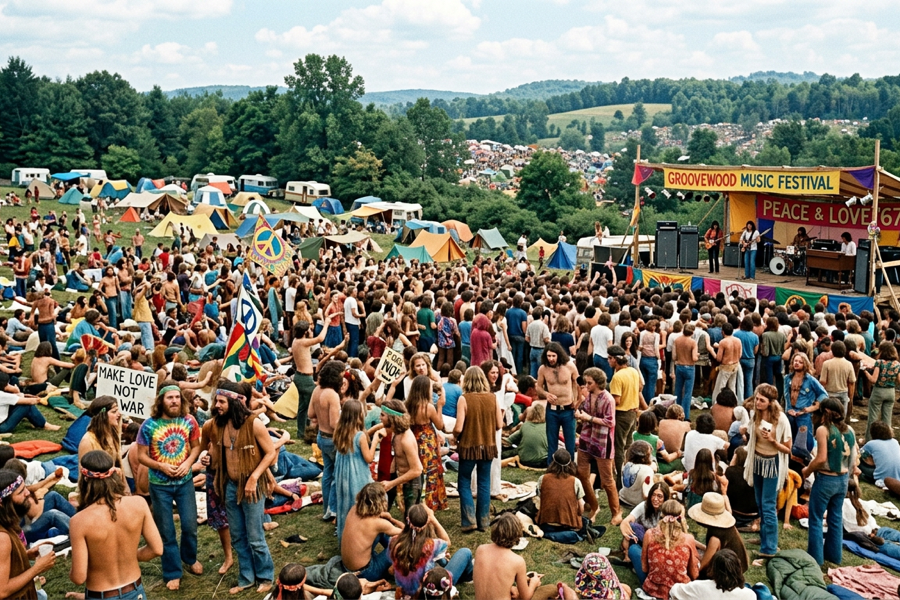
Despite, or perhaps partly because of, the continued civil unrest of the decade and the dreaded draft for the Vietnam War dominating conversation, toward the end of the 1960s, America’s youth were looking to be a little more groovy. As much as the Beatles or Martin Luther King’s March on Washington, the counterculture and hippies are fixed in popular imagination as defining the decade. When Harvard psychologist and advocate for psychedelic drugs Timothy Leary encouraged young people to “turn on, tune in, drop out,” his words resonated with disenfranchised youth, and a rejection of social norms and the establishment spread like wildfire across college campuses. (Leary later lamented that his more detailed research had been misinterpreted as “Get stoned and abandon all constructive activity.”)
Sexual liberation, radical thinking, and drug experimentation began to characterize the countercultural movement, and long hair (longer, even, than the Beatles’ had been!), loose-fitting tie-dyed clothes, and peace symbol medallions became the uniform. Soon enough, “hippie” was a derogatory term, and while the Summer of Love attracted widespread cynicism, the “flower children” proved their anti-materialist and anti-war principles at 1967’s March on the Pentagon.
Although the charts of the late 1960s were dominated by The Sound of Music soundtrack, music was also taking notes from the countercultural movement. Folk artists such as Bob Dylan and Joan Baez embraced the more meaningful hippie ideals, at the same time as psychedelic rock anthems, such as Jefferson Airplane’s White Rabbit and the Beatles’ Lucy in the Sky With Diamonds, became mainstream. A riot of sound and color, the hippie music scene would reach its zenith in August 1969, outside the small town of Bethel, New York.
Increasingly, our LifeBook Memoirs authors recall their memories of the 1960s with a singular question: “Woodstock; were you there?” The ultimate 1960s festival, Woodstock Art and Music Fair was three days of peace and music, with thirty-two of the best contemporary acts performing. These included the Grateful Dead, Creedence Clearwater Revival, and Sly and the Family Stone, and culminated in Jimi Hendrix’s provocative, psychedelic rendition of The Star-Spangled Banner. Although it lasted for only three days, the event energized a generation and continued to influence music culture well into the next decade.
The Swinging Sixties was a time of rebellion and restlessness, of idealism, struggle, and transformation. Culture was more diverse than ever before, and music evolved and splintered into new and exciting genres. The collision of free love and fear of the draft lottery made this period one of heightened emotion for America’s teenagers, living on in vivid, psychedelic-colored memories.
Did this article prompt recollections of your 1960s youth? Contact LifeBook Memoirs today to enquire about preserving your stories for your family.
Written by Isabella Samuels, LifeBook Memoirs editor