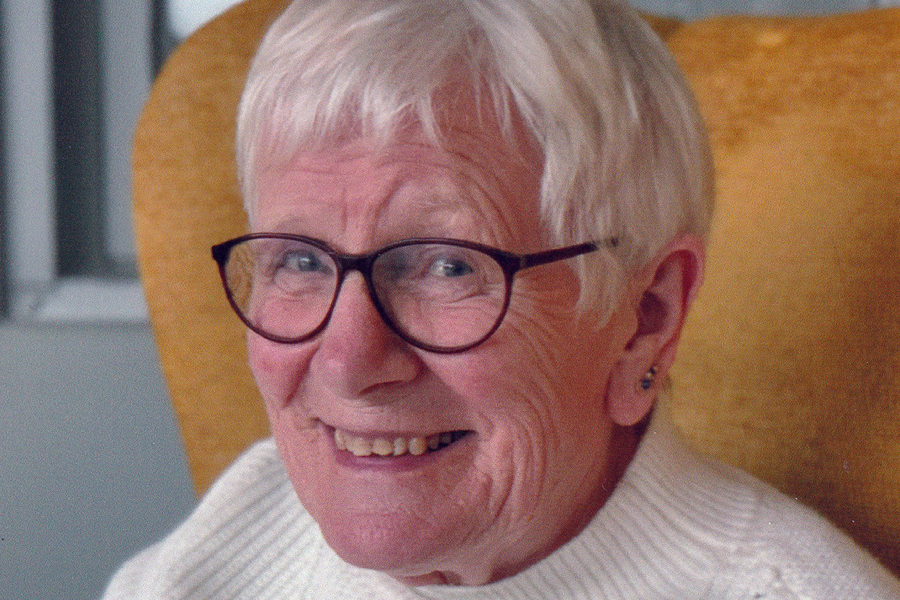
A couple of months ago, we recalled the recent LifeBook Work Hard, Play Hard by Peter Danson. In today’s post, we reflect on his wife Sue’s memoir, which she completed with Peter’s project. As always when couples undertake projects side by side, it was fascinating to hear more about Sue and her account of their life together.
From Yorkshire to the wider world
Sue was born in Yorkshire, England, just fourteen days after D-Day in 1944. Her father was not living in Britain at the time, and her mother had journeyed from Cornwall, where she was living with her sister (at the behest of Sue’s father, who wanted to make sure that, should the baby be a boy, he would be able to play cricket for the Yorkshire County Cricket Club!) So, much like Peter, it seems that Sue was destined for a sporting life from the start.
Sue’s father had been a conscientious objector during World War Two. Committed to pacifism but not wanting to cause any problems for his siblings while they were serving, he went abroad to work for a charity. In 1940, he was sent to work on the leper settlements in eastern Nigeria, where he became the settlement treasurer and architect. Shortly before leaving, he was advised to do a short course in nursing, and it was while at the training hospital that he met a staff nurse—Sue’s mother.
Having given birth to Sue in Yorkshire twenty months later, Sue’s mother made the long voyage back to Nigeria to reunite the family. Sue says, “I met my father for the first time when I was twenty months old. Apparently, I screamed in his face because I had no idea who he was.”
The bush was an exciting—albeit sometimes dangerous—place for a toddler. Snakes were common, as were mosquitoes and soldier ants, which Sue had a painful encounter with when she was two or three. When required, Sue’s mother continued as a nurse, and she would often be called on to assist with surgeries. Sue recalls that she idolized her mother and can remember operating on her teddy because she wanted to follow in her mother’s footsteps and become a nurse: “I would just do big stitches over any cuts or tears, just as if I was a professional operating on a patient.”
Education was not a priority in Nigeria, and whenever Sue’s mother suggested homework, Sue would dash off on her bicycle! By the time she was five years old, her parents resolved that it was time for her to go to school in England, and she returned to the U.K. in 1949. After a short stay with family on a farm in Cornwall, in the deep south-west of England, Sue started at a boarding school run by nuns. After a difficult start, she made friends and became immersed in school life.
Sue recalls, “It was awful if you got the giggles in chapel, and, of course, I got them frequently. We were always under scrutiny, so we got very good at being able to laugh without actually making any noise. We could tell when someone was giggling, though: when their shoulders were shaking because they were laughing but trying to stay silent. That alone was enough to set the next person off, and then the next. The best thing, though, was when, out of the corner of your eye, you might see one of the nuns catching it as well. That was even funnier.”
Where sports took hold
Sports also became an increasingly important part of Sue’s school life as she progressed to doing gymnastics and playing field hockey and netball, a sport that has its roots in basketball but which does not permit physical contact.
Around the age of sixteen, Sue’s interest turned from nursing to pharmacy. Lacking the grades for this, she discovered physiotherapy—she went on to qualify as a physiotherapist in Manchester, in 1965. A field that included both sports and sciences seemed like the perfect career for her.
Before Sue could continue with postgraduate training, she spent a few months working at a charity hostel in the Royal Docks area of London. Her story of working in the mission kitchen around Christmastime has stayed with me. Having prepared trays of braised steak bathed in gravy, with roasted potatoes and vegetables, she lifted one of the trays out of the oven, ready to serve up, when she moved her hands to get a better grip on it. The tray tipped, and meat and gravy splattered the recently cleaned floor. Hearing hungry feasters outside the door, she and her colleague scooped it all up and sheepishly served it. After a while, there was a knock at the kitchen door; the person standing there said they had never eaten a meal that tasted so good. Sue and her boss felt vindicated!
Sue began further physiotherapy training at the historic Devonshire Royal Hospital in Buxton, in the English county of Derbyshire. It was while training there that a colleague invited her to play in a local field hockey match, at which she would meet her future husband, Peter. As recounted in the post about Peter’s LifeBook, he played the ball onto Sue’s ankle, to which she quipped, “I’ll get you for that!” At the pub afterward, they discovered they had much in common. “We just seemed to naturally click,” Sue recalls.
In 1966, Peter and Sue bought a ring together, deciding to keep their engagement quiet for a few weeks. A month later, when they were spending Christmas with her cousin, they agreed to break the happy news. At church on Christmas Eve, Peter put the ring on her finger at the stroke of midnight, although it wasn’t until the following morning that Sue’s cousin and his wife saw what had been added to her left hand! They married just over a year later, during which time they continued to play field hockey, and Sue was named captain of the local women’s team.
Children Jennifer and Michael soon joined the family. Sue worked part-time, running fitness classes and picking mushrooms on a farm. When the children were older, she returned to working as a physiotherapist once more.
When Jennifer was selected to play for the Derbyshire under-sixteens’ netball team, Sue accompanied her to all her matches and often umpired too. When the head coach discovered that Sue was a qualified physiotherapist, she asked her to step in as the team’s physio when necessary. Following this, she subsequently became physiotherapist for England Netball, with whom she traveled to Malta, Canada, and New Zealand. To the team’s surprise, netball was so popular in New Zealand that during their first tour of the country, the team was recognized by people who had seen them play on TV. Sue was shocked when she went into one shop and the lady behind the counter commented, “You did a lot better last night, didn’t you?”
After leaving England Netball, Sue continued working for Derbyshire and East Midlands Netball and later with Netball Super League. Her career transitioned after she developed arthritis, but, still revered, she was asked to become the manager of the talent squad. Sue also set up a team for younger children, teaching them the basics of netball while, at the other end of the spectrum, introducing a Back-to-Netball program aimed at older people who wanted to return to the sport to keep fit.
For her contribution to the sport of netball, Sue was nominated for the local Recognition of Service Excellence (ROSE) Award and, thereafter, the national award, which was presented at a ceremony known as the Goalden Globes.
All Sue’s netball work was voluntary. She still had a full-time job in the National Health Service but used her holidays and weekends for netball. The players all had jobs and gave up their weekends too, such was their love of the sport.
Despite the accolades she has received, Sue says that her family is the thing she is most proud of: “My biggest and most joyous achievement is the family I have now. I am so proud of how close we all are.”
With Sue’s infectious energy and humor springing off every page of her LifeBook, I am sure they are equally proud of her.

Written by Isabella Samuels, LifeBook Memoirs editor