People can sometimes feel awkward when asked to share the story of their life.
“What’s so special about me?” they might ask. “My life has just been ordinary.”
Early in my writing career, I had a similar conversation with another young writer who had traveled extensively and had lived in Australia, India, Greece, and other exotic places. Among his adventures, he had earned a living punting tourists around lakes in northern India and running a youth hostel on a Greek island. He had so much to write about, I insisted, whereas I had grown up in a middle-class family on a suburban housing estate and had lived a very ordinary life, doing ordinary things. He looked at me, and said, “I haven’t done any of those things or lived in the places you have.”
To him, my life was just as exotic as my perception of his. I have carried that lesson with me ever since—everybody’s experiences and memories are unique and interesting. I love discovering them.
The uniqueness of our personal experiences
Most of us have a car. In the U.S., more than nine in ten households have access to at least one vehicle. Having a car, therefore, is so commonplace it cannot be anything of interest, surely? But what we dismiss as merely commonplace can become unique through our experiences of them and how they impact our lives. However, the richness of those experiences is often realized only once you share your memories.
I have a lot of my father’s old holiday photos, and there is a recurring theme. Many of these photos feature whatever car he was driving at the time set against a landscape: his Morris Oxford nestled into the rolling hills of the Scottish Borders, the Commer van he had converted into a camper van parked up in the dunes at La Rochelle, France, and a big Renault 18 estate sitting outside a Hansel-and-Gretel Austrian guesthouse. Whenever we were on holiday and my father was taking photos, my mother had to remind him that we were there too and that perhaps we could appear in some of the pictures. Now that he has gone, those photos prompt memories of the times we shared. They remind me how valuable it can be to share your memories, if only to give others something to hold on to later.
Closing the generation gap
In his later years, my father loved to tell stories from earlier in his life, and a lot of those memories revolved around whatever car he had at the time. This might seem limiting, but that was not the case because independent transport was a revolutionary experience for his generation. It shaped the way they viewed the world and the stories they told. People of his parents’ generation often never left their hometown or village; in contrast, car ownership enabled my father not only to travel the length of the country but then Europe. It gave him a freedom that his parents never had and one that my generation takes for granted. Hearing him share his memories helped me to understand just how profound that shift really was.
Those reminiscences of my father showed insights into his character. When he was an excise officer in the Borders countryside in the 1950s, he had to drive to remote distilleries and warehouses in all weathers. His little car—I do not remember the make, but I remember the story—struggled when the weather became bad, and he often ended up wheel-spinning in the mud, snow, and ice, unable to move. He learned to take some old Hessian sacking with him to place under the tires, so they had something to grip. The problem with that was he had to stop the car to retrieve the sacking, so the process repeated. He then had the bright idea to tie the sacking to his back bumper with a long piece of rope, so the sacking dragged along behind until it was safe to stop and retrieve it.
It’s not the cars, but the memories they spark
The cars themselves don’t really matter so much in these shared memories. But the sense of liberation and broadening of horizons does, along with all the recollections associated with them. Now, when I look at those old family photos, I see far more than just a car in a landscape. I remember sitting in the back of that old Renault 18 and that very particular sensation of a car’s engine laboring on the brink of giving up as we climbed a steep mountain pass in the Austrian Alps. The final straw came when we caught up with an even slower lorry and the car lost momentum. Somehow, we swung into a lay-by and turned to stop at the first guesthouse on the way back down, where I had my first ever Wiener schnitzels. All these memories, including the gut-churning sensation of the car engine struggling to crawl up the steep mountain pass, come from that photo. It is the perfect reminder of the way in which treasured memories can be prompted by something as simple as an old photograph.
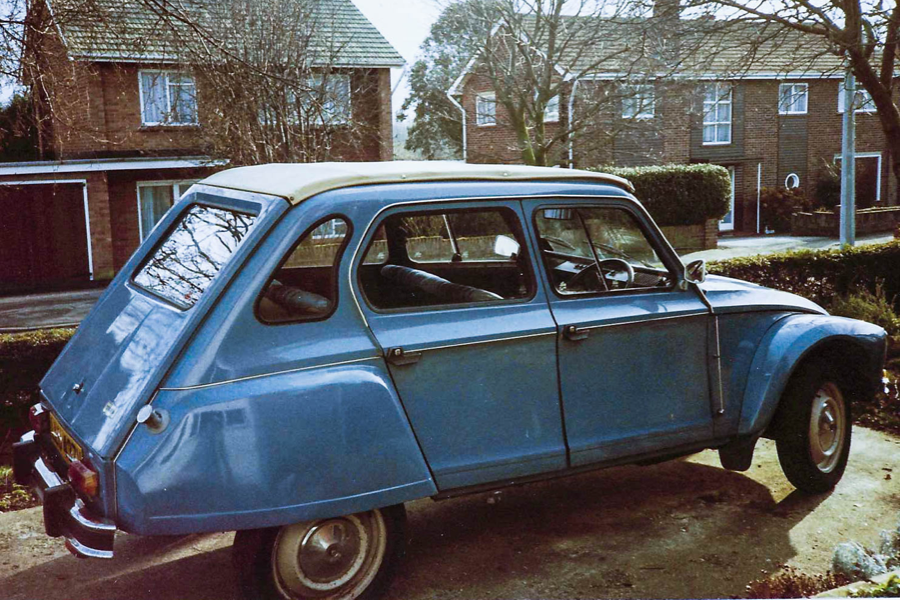
I am not nearly as obsessed with cars as my father was. Perhaps that is a generational thing because cars have not been revolutionary or liberating for me. But … my first car was a Citroën Dyane that my father bought and worked on. When I think of that car, it is not so much the detail of the vehicle that I remember, but the events and experiences that it was a part of or which it made possible. I remember how its little 602cc engine struggled with one-in-three hills in Wales, the pride my father took in how he refurbished that little car, and the connection I had with him because of it. It was an ordinary car, part of an ordinary life, but it was also part of something unique. Maybe one day future generations will smile and roll their eyes as I recount another story about that little car.
Written by Keith, LifeBook Memoirs ghostwriter