Over the last year, I’ve been helping my father write his memoir. We’re about halfway through the project now, but just last week, he was admitted to the hospital with congestive heart failure, his heart functioning at just 16 percent.
In life, you never know what’s coming, and that’s the hard truth of it. I say that as a ghostwriter at LifeBook Memoirs, as someone who helps families capture their life stories for a living. And yet, I’m still learning this lesson myself.
I recently read something that has stayed with me – that everyone has an invisible number posted on their forehead, counting down how many more times we will see that person. We don’t know what the number is, but it’s always there, whether we see it or not. You never know when the ‘last time’ is happening.
I’m hopeful I’ll have many more years with my dad, and I extend that same hope to you and your family, but I also know that hope is not a plan. So, let’s talk about why today (and not someday) is the right time to start writing your life story and preserving family memories.
The stories we assume will always be there
Trust me, I understand procrastination. I waited until my grandfather was ninety-five before I finally helped him write his memoir. (We did finish it, and he’s still with us, going on ninety-seven.) But by then, his memory had become somewhat jumbled compared to the crystal-clear stories he told even just a few years prior.
I caught one of the discrepancies firsthand. I asked about his earliest memory, which is always a tricky one to pin down. He knew with certainty that it involved a broken bone.
“Dad had to get the two mules out,” he told me, “hook up the wagon and haul me all the way to Brewton – about a ten-mile trek – so the local doc could fix up my leg.”
He said confidently that it happened when he fell out of a pecan tree. But I knew, from having heard the stories so many times, growing up, that it was his sister who fell from the pecan tree. She broke her arm. I gently jogged his memory.
“Oh, yes,” he said, eyes brightening as a veil lifted. “You’re right. I fell off an old trunk and hit the ground in a funny way, snapping my arm, not my leg.”
My grandfather is one of the lucky few who still retains a sharp mind, but that isn’t everyone’s path. Memory is a fragile, uncertain thing. In truth, we are all terribly unreliable witnesses.
Here’s the thing about memory that most of us don’t realise: it isn’t a recording. It’s a retelling. Every time you reach back for a story, you’re not retrieving it unchanged.
Think of it like writing your life story in pencil. Every time you reach back to review it, you might smudge a word here or re-write a line there. A detail may shift, like someone’s name, the colour of a dress, whether it was your arm or your leg. Whether it was a pecan tree or an old trunk. Each time you think back, you reconstruct and colour it with how you feel in that particular moment. When you set the memory back down, the version you’ve just told becomes the new original.
That’s why real memory and remembered memory quietly trade places over time, and you never know when it’s happened. It’s not a flaw; it’s just how we’re made. But it does mean that the stories we assume will always be there are already in the process of becoming something slightly different.
What I never expected to learn – not from reading about memory but from sitting with someone inside it – was that not everything drifts in the same direction. I once worked with a client who had recently been diagnosed with dementia. She wanted to get her family legacy down on paper while she still had clarity.
As the project progressed over months, I witnessed her memory drift in real time. Names and dates became muddled; her river began to flow backward. However, her heart-archive never disappointed, and love was always at the centre of her life story. The root she shared was joy, and that always came through in the telling.
If you are feeling that bone-knowing whisper to “Write my story”, please don’t wait. You will never be as river-clear as you are today.
What gets lost when a life goes unwritten
Within my own family, I’ve always been the designated family historian. I suspect most families have one, and I’m fairly certain it’s something you’re born into.
My earliest memory of the role was in elementary school, when I asked my grandma if I could interview her for extra credit. I asked the kinds of questions only a child would think to ask. Who was your childhood crush? What did you do for fun when you were my age? What music did you like? But my favourite question was, what was the most daring thing you did as a child? With that, I was rewarded with a fantastic story about how, when she was nine years old (my age at the time), she secretly rode her horse through the house to impress her friends. And she was never caught!
My grandma came from a long line of firecracker women with strong voices and independent attitudes. Hearing her speak so freely in that recording and just being her authentic self gives me perspective on my own values, even now.
My grandma left us too soon. When she passed, everyone in the family wanted a copy of that silly little interview. (They all got one.) And I’ll tell you this much: I’m glad I did the extra credit.
If I could do that in elementary school with nothing but curiosity and a tape recorder, you can do it now.
Why this generation’s stories matter more than ever
We are living through a period of unprecedented demographic change. As of the 2020 US Census, one in six Americans were sixty-five or older – a shift driven almost entirely by the Baby Boomers, born between 1946 and 1964. The situation is slightly more marked in the UK. By mid-2020, about one in five Britons were aged sixty-five or over – a significant demographic shift in its own right.
The lived experience within this generation is unlike any previous era. They were born into homes without televisions and yet they now carry supercomputers in their pockets. They witnessed organ transplants go from science fiction to routine surgery. They witnessed the entire history of space travel: first satellite, first human in space, moon landing, Mars rovers, private space tourism – all within living memory.
These memories are held by people who are still with us, but the window to capture their stories and create a family heirloom for years to come is closing.
The moment you realise it matters is usually too late
Most people do not wake up one morning thinking, “Today is the day we preserve my mother’s life story.” Few begin a project like this because the timing feels perfect. They usually start much later, with a scare, a diagnosis, a funeral or a sobering moment of regret. They get going only when something shifts – when an adult child realises there are questions they never asked, stories they never wrote down and details they assumed would always be there.
For an adult child, that realisation can be painful. We assume there will be more time. More holidays, more visits, more ordinary afternoons in which to say, “Tell me again how you met” or “What were you like at twenty?” Love, however, has a way of making tomorrow feel guaranteed, until it doesn’t.
We tell ourselves that we’ll do it next summer, after the holidays, when work settles down, when everyone feels less busy. But life doesn’t wait. And by the time a story feels urgent, memory may already be shifting and energy may already be limited. The chance to ask may be gone.
That is why a memoir so often begins as a gift, not only to the person telling the story but to those who will one day wish they had asked sooner.
How a LifeBook looks and feels
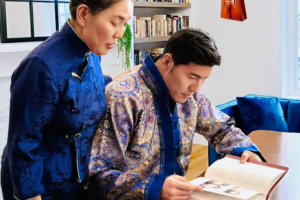
At LifeBook Memoirs, the process begins with slow, in-person interviews. These are unhurried conversations where trust and openness build naturally over time. You simply have to show up and talk while we listen.
As a ghostwriter, I listen to each story multiple times, translating the spoken word into an engaging narrative on the page. The goal is for the finished book to bring a genuine sense of fulfilment and for it to feel like you.
EnhBuren Tsegmid, whose memoir Gratitude of a Hybrid Woman was completed in 2026, put it this way: her interviewer and ghostwriter “devoted their hearts, effort and professional skills to bringing this book to life”, attending even to the nuances of her spoken-English accent. That level of care is what we aim for with every project.
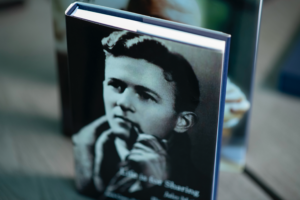
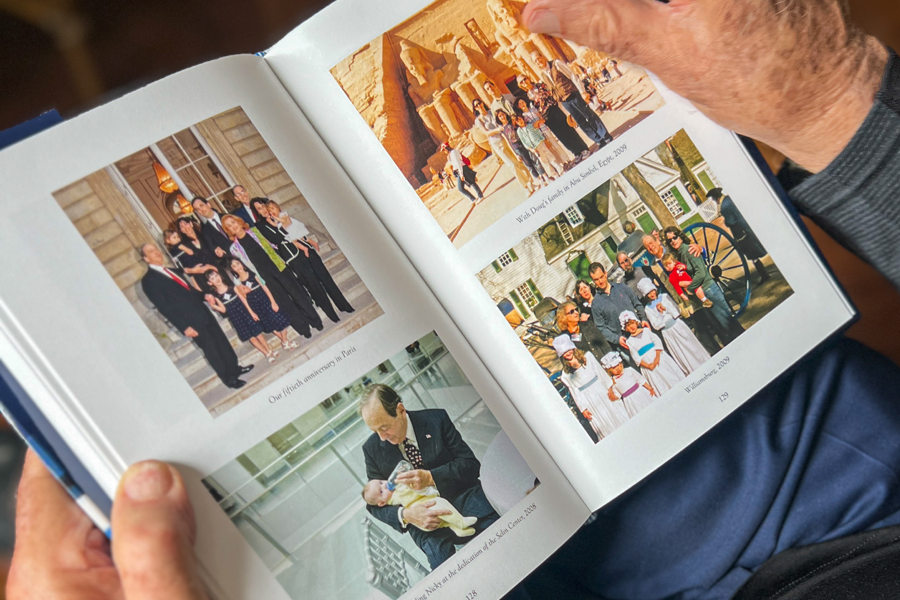
The physical book itself is a treasure to hold. It’s printed on archival Mohawk paper, which is the highest quality available, resistant to fading for 500 years or more. It’s luxuriously hand-bound by traditional English bookbinders in London who sew the pages with a needle and waxed linen thread, stitch the spine to lie flat and finish it with cloth or leather-wrapped boards. This level of devotion treats a life story as what it is – a one-of-a-kind work of art.
Each LifeBook is finished in a custom dust jacket with your chosen photograph and title. It will reflect and feel like your personal taste and serve as a family legacy that you can share and pass down.
The real question: If not now, when?
To capture a parent’s life story is a profound privilege. But there comes a moment, too, when the question turns quietly toward you. What stories do you carry that no one else can tell in quite the same way? What values, memories, hardships and turning points will vanish or blur if you never set them down?
With my father in his hospital bed and the weight of his unfinished memoir in my hands, I’m grappling with the irony of my own advice in this article. I’m so grateful he’s still with us. And now, when I visit him, he continues telling me his story. I get to listen, witness and preserve our family memories. It reminds me that a life story is never only about looking backward. They are also about recognising that your own life is becoming part of the legacy that your family will one day hold onto.
If you don’t know where to begin, NPR and Word Studio offer helpful prompts, with questions like “Why is writing my story important to me?” Clarifying your “why” will give you a north star for the whole project.
The hardest part, as with most meaningful things, is simply beginning. Indeed, an old Chinese proverb says that “a journey of a thousand miles begins with a single step.” So, if not now, when?
Whether you are hoping to preserve a parent’s memories or tell your own story, LifeBook Memoirs can walk you through every step. You’ve lived a good life. Let us help you write your story.
Written by Bailey, LifeBook Memoirs ghostwriter