A dementia diagnosis may be devastating for the person receiving it, and it can feel like the end of hope for a happy future, but it’s not the end of the story for that person or for those who love them. Those living with dementia still have the capacity for joy and for sharing their thoughts and memories. Reading to parents with dementia and reminiscing and storytelling with them have a powerful part to play in keeping them connected with themselves, their loved ones and the world around them.
What is dementia?
Over 57 million people live with dementia worldwide, according to the World Health Organization. It is a major cause of disability, dependency and death among older people and can have significant economic, practical and emotional consequences for families and carers.
Dementia is an umbrella term that encompasses a number of progressive brain conditions, the most common of which are Alzheimer’s disease, vascular dementia, frontotemporal dementia and Lewy body dementia. Normal brain function is the product of messages sent between neurones – nerve cells – but dementia damages neurones so that messages cannot be sent effectively in the brain and to other parts of the body. This damage affects cognitive ability, communication, mood and behaviour and leads to memory loss, confusion, loss of speech and understanding, loss of ability to perform everyday activities, loss of mobility and many other symptoms. More detailed information is available from organisations such as Alzheimer’s Society and Dementia Society of America.
What is the best way to help a person with dementia?
There is currently no cure for dementia. Medication can ease symptoms, but non-pharmacological interventions are preferred by experts as the first line of treatment. These approaches aim to improve quality of life and daily functioning, with support taking the form of rehabilitation, social engagement, physical activity or cognitive stimulation.
Relatives and carers can play an important role in providing support, including participating in activities such as reading, reminiscence therapy and creating life story books.
How can reading help a person with dementia?
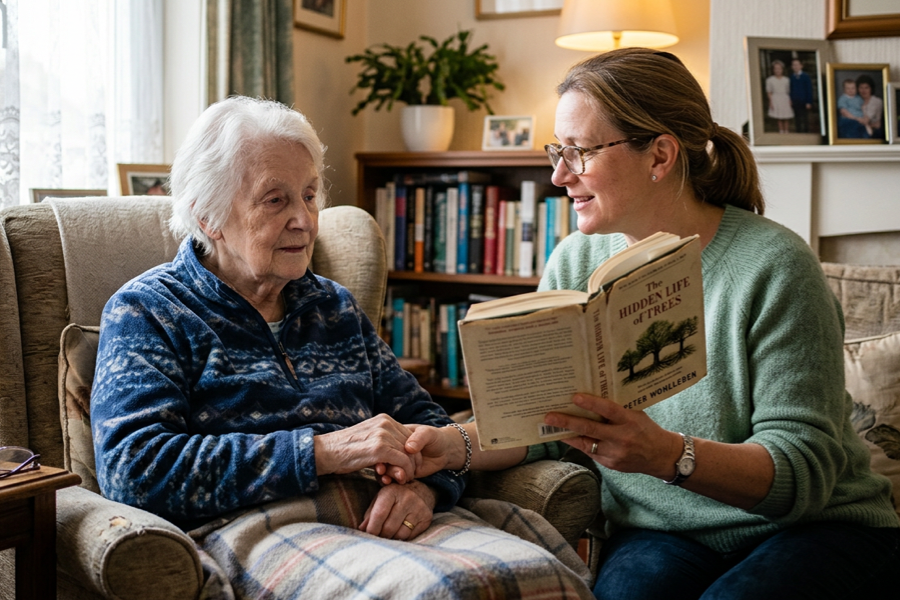
Reading to parents with dementia can support their mood, memory and sense of connection with the people around them. Each person with dementia experiences symptoms in their own way, and some are able to continue reading by themselves. Others lose the capacity to concentrate on printed matter, engage with text in an orderly way or process written language effectively. They might, however, still be able to engage with reading as a shared experience.
Research into the benefits of shared reading for people with dementia is still limited, but projects such as Read to Care, run by The Reader, a charitable organisation that facilitates shared reading sessions in community settings, indicate that reading short poems with people with dementia creates positive experiences for them. “Isn’t it funny?” one participant in Read to Care remarked at the end of a reading group session. “We come in with nothing and go out with all these thoughts.”
Read to Care concludes that reading poetry in a group seems to ‘trigger’ the ability to access memories and awaken consciousness, acting as “an emotional linguistic stimulus for the temporary but recurrent recovery of […] core autobiographical experience and identity in a person.” For the spouses or children of dementia sufferers, who may feel that they are losing their loved one as that person loses their memories, a response to thought-provoking poetry can feel like getting a glimpse of the person they once knew.
Guardian journalist Jo Glanville describes reading to her parents, both of whom had dementia, as one of the key activities that broke through the confusion robbing them of connection with the outside world. Both responded positively to the stories, poems and novels she read to them and were able to follow a story. For them, reading provided a way to communicate, and in the case of Jo’s father, it revealed that his dementia symptoms masked sharper thinking than anyone realised.
What is reminiscence therapy?
For people with dementia, connection matters, and reminiscence therapy and family history are two of the most effective ways to build it. Reminiscence therapy emerged from the observation that older memories are better preserved than recent memories in dementia. It is now an established treatment method that uses familiar objects, music, photographs or storytelling to connect individuals with older memories, and in so doing, supports engagement, improved mood and identity.
Structured reminiscence therapy is usually conducted by professional therapists, often in memory cafes or day services. According to charity dementia.co.uk, carers can also support reminiscence sessions at home for a person with dementia by following a few simple steps.
- Gather a small selection of photographs, music and objects related to the person’s past.
- Sit down quietly with them, show them one item at a time and ask open questions such as, “What can you tell me about this?”
- Listen and respond with warmth and curiosity to what they say, but do not test or correct them.
- Over time, create a life story book with the memories inspired by reminiscence sessions.
Reminiscence therapy taps into deeper and emotional memories in a structured way, encourages communication and helps preserve a person’s identity. Cristina C. Murdock, MD, a geriatric medicine specialist, highlights that listening to or sharing a story triggers activity in multiple areas of the brain. This activity promotes engagement that may help slow cognitive decline by keeping the brain active and building cognitive reserve.
As an illustration, she describes a visit to a patient living with dementia; when the patient’s daughter mentioned that her mother had been a seamstress, “the patient’s face lit up as she described the decades she spent making wedding dresses, and the joy that work brought her.” For this patient, a small prompt brought a flood of happy memories, and for her daughter, for just a little while, the mother she once knew was restored to her.
What is a life story book for dementia care?
Life story books are a form of person-centred care in which a person with dementia and/or their family collects and compiles objects and information about their life. Through guided conversation, this information is used to encourage recall and focus on past events and people.
Although more research is required to fully establish the benefits of the life story book method in dementia care, evidence of the following positive effects is summarised in a systematic review of existing literature published in PLOS ONE:
- Maintenance and promotion of personhood
- Improved autobiographical memory
- Improved mood
- Improved communication
- Improved memory
- Improved cognitive function
- Improved quality of life
- Increased sense of self-integrity, identity, wellbeing, pride and self-esteem
- Improved behaviour
- Better relationships with family, friends and caregivers.
To be clear, there is currently no cure for dementia, but reading, reminiscence therapy and family history or life story books can lead to meaningful improvement in the experiences of those living with dementia.
Can storytelling help people with memory loss?
The spoken word and memory loss are closely connected for people with dementia, and storytelling can be one of the most powerful ways to reach someone who has lost other means of communicating. Among its many symptoms, dementia affects memory and communication, and losing the ability to understand, connect and feel like themselves can be distressing for those with dementia and for their families and carers. The website Alzheimer’s In Your Home, which provides information and resources for carers, says storytelling can help bypass communication barriers and memory loss.
For a person with dementia, telling, retelling or hearing about familiar or precious stories from their past might trigger feelings of joy or nostalgia associated with that moment. It might also gently remind them of people and events in their life in a way they can no longer access spontaneously and at will.
Stories and connections can be found in many places. The daughter of an elderly man with Alzheimer’s reported, for example, that she read aloud a letter sent to her father by an old friend describing their early days of working together in the 1950s. The names of old friends, memories of lunch in the canteen and the odd tasks they’d once done together were enough to make him laugh in recognition of past happiness. Rediscovering these moments brought him joy and his daughter the comfort that an intelligent man was still there.
Is it too late to record my parent’s life story if they already have dementia?
With the right support, those in the early stages of dementia can tell their stories in a detailed and comprehensive way. The process of storytelling may also have beneficial effects for the person, encouraging and enabling them to retrieve stories. As a person progresses through moderate and late-stage dementia, however, communication and the ability to retrieve memories are increasingly negatively impacted and the possibility of capturing a meaningful record diminishes. The lesson here is not to wait. Recording parent stories before Alzheimer’s or another form of dementia takes hold gives you the best chance of capturing them in full. If your loved one is in the early stages of dementia, the time to start working on their life story is now.
The website dementia-activities.com says techniques for encouraging and developing storytelling vary according to the person and where they are in their dementia journey. In the early stages, written journaling by the individual, or detailed interviews, may be appropriate and offer the possibility of creating a memoir-style full account. Caregivers and family members can support this kind of intensive activity, perhaps by capturing interviews on video or by participating in maintaining and supplementing a journal.
How to capture a parent’s life story is a question many families face once dementia has been diagnosed, and professional memoir-writing services can offer a structured way to record a loved one’s life experiences, hopes and thoughts before they can no longer recall or communicate them. They can guide those who want to tell their stories from the initial decision to start writing right through to the creation of a completed memoir.
The benefits of creating a memoir, complete with photographs, are immeasurable in terms of emotional connection, legacy and historical documentation. Many of the families of those who have written their memoirs while living with dementia report that, for their loved one, the book of their life became a resource through which they could rediscover their own past. For families, a memoir is a way to preserve a parent’s voice: a precious storehouse holding the story of a life vividly lived, even after the person is gone.
Wendy Mitchell, dementia sufferer and author of Somebody I Used to Know, describes her dementia as a “thief in the night,” stealing away her precious mental pictures of her past life. For her, her ghostwriter, Anna Wharton, was “that writer in the night filling in the Post-it notes while I slept,” restoring what dementia has taken from her. “I couldn’t tell you what’s in my book,” she says in a Granta article. “But if you read me a piece I would instantly know that it was me.”
Why do life stories matter?
“Only connect!” the epigraph to EM Forster’s novel Howard’s End urges us, telling us that stories are the means by which we build meaningful connections with each other. Stories are intrinsic to human experience, and we have told them for millennia. Telling stories, so we can share what’s only in our own minds and imaginations, is what makes us human. In fiction, we create worlds; in life stories, we share our worlds.
Our brains are hard-wired to tell stories about ourselves and the world around us. We remember and process information more effectively when it is delivered as a story. For humans, stories help us to:
- Build connection
- Acquire identity
- Impart knowledge
- Develop cognition
- Learn perspective and understand the perspective of others
- Build empathy
- Sustain a sense of a shared culture and morality
- Solve problems
- Discover and understand concepts
- Learn wisdom.
In short, stories, whether fiction, non-fiction or biographical, are essential to our understanding of ourselves, to our relationships with others and to our apprehension of the world around us.
People who sit down to write their life story often do so because they regret that they know so little about their parents’ lives and are no longer able to ask. Perhaps those parents left little in the way of written documentation behind, perhaps they talked little of their childhoods or the world they grew up in, or perhaps dementia robbed them of the capacity to share the stories they wanted to tell. They write their own stories to avoid leaving to their children a similar legacy of regret.
For those still enjoying the benefits of living parents, capturing their life stories on paper, on video or by some other method is a way of building and maintaining connection with them. If they are living with dementia, writing and then reading their own life story can improve their memory, mood, cognition and quality of life. Leaving a legacy before memory fades is one of the strongest reasons
A dementia diagnosis may be devastating for the person receiving it, and it can feel like the end of hope for a happy future, but it’s not the end of the story for that person or for those who love them. Those living with dementia still have the capacity for joy and for sharing their thoughts and memories. Reading to parents with dementia and reminiscing and storytelling with them have a powerful part to play in keeping them connected with themselves, their loved ones and the world around them.
What is dementia?
Over 57 million people live with dementia worldwide, according to the World Health Organization. It is a major cause of disability, dependency and death among older people and can have significant economic, practical and emotional consequences for families and carers.
Dementia is an umbrella term that encompasses a number of progressive brain conditions, the most common of which are Alzheimer’s disease, vascular dementia, frontotemporal dementia and Lewy body dementia. Normal brain function is the product of messages sent between neurones – nerve cells – but dementia damages neurones so that messages cannot be sent effectively in the brain and to other parts of the body. This damage affects cognitive ability, communication, mood and behaviour and leads to memory loss, confusion, loss of speech and understanding, loss of ability to perform everyday activities, loss of mobility and many other symptoms. More detailed information is available from organisations such as Alzheimer’s Society and Dementia Society of America.
What is the best way to help a person with dementia?
There is currently no cure for dementia. Medication can ease symptoms, but non-pharmacological interventions are preferred by experts as the first line of treatment. These approaches aim to improve quality of life and daily functioning, with support taking the form of rehabilitation, social engagement, physical activity or cognitive stimulation.
Relatives and carers can play an important role in providing support, including participating in activities such as reading, reminiscence therapy and creating life story books.
How can reading help a person with dementia?
Reading to parents with dementia can support their mood, memory and sense of connection with the people around them. Each person with dementia experiences symptoms in their own way, and some are able to continue reading by themselves. Others lose the capacity to concentrate on printed matter, engage with text in an orderly way or process written language effectively. They might, however, still be able to engage with reading as a shared experience.
Research into the benefits of shared reading for people with dementia is still limited, but projects such as Read to Care, run by The Reader, a charitable organisation that facilitates shared reading sessions in community settings, indicate that reading short poems with people with dementia creates positive experiences for them. “Isn’t it funny?” one participant in Read to Care remarked at the end of a reading group session. “We come in with nothing and go out with all these thoughts.”
Read to Care concludes that reading poetry in a group seems to ‘trigger’ the ability to access memories and awaken consciousness, acting as “an emotional linguistic stimulus for the temporary but recurrent recovery of […] core autobiographical experience and identity in a person.” For the spouses or children of dementia sufferers, who may feel that they are losing their loved one as that person loses their memories, a response to thought-provoking poetry can feel like getting a glimpse of the person they once knew.
Guardian journalist Jo Glanville describes reading to her parents, both of whom had dementia, as one of the key activities that broke through the confusion robbing them of connection with the outside world. Both responded positively to the stories, poems and novels she read to them and were able to follow a story. For them, reading provided a way to communicate, and in the case of Jo’s father, it revealed that his dementia symptoms masked sharper thinking than anyone realised.
What is reminiscence therapy?
For people with dementia, connection matters, and reminiscence therapy and family history are two of the most effective ways to build it. Reminiscence therapy emerged from the observation that older memories are better preserved than recent memories in dementia. It is now an established treatment method that uses familiar objects, music, photographs or storytelling to connect individuals with older memories, and in so doing, supports engagement, improved mood and identity.
Structured reminiscence therapy is usually conducted by professional therapists, often in memory cafes or day services. According to charity dementia.co.uk, carers can also support reminiscence sessions at home for a person with dementia by following a few simple steps.
- Gather a small selection of photographs, music and objects related to the person’s past.
- Sit down quietly with them, show them one item at a time and ask open questions such as, “What can you tell me about this?”
- Listen and respond with warmth and curiosity to what they say, but do not test or correct them.
- Over time, create a life story book with the memories inspired by reminiscence sessions.
Reminiscence therapy taps into deeper and emotional memories in a structured way, encourages communication and helps preserve a person’s identity. Cristina C. Murdock, MD, a geriatric medicine specialist, highlights that listening to or sharing a story triggers activity in multiple areas of the brain. This activity promotes engagement that may help slow cognitive decline by keeping the brain active and building cognitive reserve.
As an illustration, she describes a visit to a patient living with dementia; when the patient’s daughter mentioned that her mother had been a seamstress, “the patient’s face lit up as she described the decades she spent making wedding dresses, and the joy that work brought her.” For this patient, a small prompt brought a flood of happy memories, and for her daughter, for just a little while, the mother she once knew was restored to her.
What is a life story book for dementia care?
Life story books are a form of person-centred care in which a person with dementia and/or their family collects and compiles objects and information about their life. Through guided conversation, this information is used to encourage recall and focus on past events and people.
Although more research is required to fully establish the benefits of the life story book method in dementia care, evidence of the following positive effects is summarised in a systematic review of existing literature published in PLOS ONE:
- Maintenance and promotion of personhood
- Improved autobiographical memory
- Improved mood
- Improved communication
- Improved memory
- Improved cognitive function
- Improved quality of life
- Increased sense of self-integrity, identity, wellbeing, pride and self-esteem
- Improved behaviour
- Better relationships with family, friends and caregivers.
To be clear, there is currently no cure for dementia, but reading, reminiscence therapy and family history or life story books can lead to meaningful improvement in the experiences of those living with dementia.
Can storytelling help people with memory loss?
The spoken word and memory loss are closely connected for people with dementia, and storytelling can be one of the most powerful ways to reach someone who has lost other means of communicating. Among its many symptoms, dementia affects memory and communication, and losing the ability to understand, connect and feel like themselves can be distressing for those with dementia and for their families and carers. The website Alzheimer’s In Your Home, which provides information and resources for carers, says storytelling can help bypass communication barriers and memory loss.
For a person with dementia, telling, retelling or hearing about familiar or precious stories from their past might trigger feelings of joy or nostalgia associated with that moment. It might also gently remind them of people and events in their life in a way they can no longer access spontaneously and at will.
Stories and connections can be found in many places. The daughter of an elderly man with Alzheimer’s reported, for example, that she read aloud a letter sent to her father by an old friend describing their early days of working together in the 1950s. The names of old friends, memories of lunch in the canteen and the odd tasks they’d once done together were enough to make him laugh in recognition of past happiness. Rediscovering these moments brought him joy and his daughter the comfort that an intelligent man was still there.
Is it too late to record my parent’s life story if they already have dementia?
With the right support, those in the early stages of dementia can tell their stories in a detailed and comprehensive way. The process of storytelling may also have beneficial effects for the person, encouraging and enabling them to retrieve stories. As a person progresses through moderate and late-stage dementia, however, communication and the ability to retrieve memories are increasingly negatively impacted and the possibility of capturing a meaningful record diminishes. The lesson here is not to wait. Recording parent stories before Alzheimer’s or another form of dementia takes hold gives you the best chance of capturing them in full. If your loved one is in the early stages of dementia, the time to start working on their life story is now.
The website dementia-activities.com says techniques for encouraging and developing storytelling vary according to the person and where they are in their dementia journey. In the early stages, written journaling by the individual, or detailed interviews, may be appropriate and offer the possibility of creating a memoir-style full account. Caregivers and family members can support this kind of intensive activity, perhaps by capturing interviews on video or by participating in maintaining and supplementing a journal.
How to capture a parent’s life story is a question many families face once dementia has been diagnosed, and professional memoir-writing services can offer a structured way to record a loved one’s life experiences, hopes and thoughts before they can no longer recall or communicate them. They can guide those who want to tell their stories from the initial decision to start writing right through to the creation of a completed memoir.
The benefits of creating a memoir, complete with photographs, are immeasurable in terms of emotional connection, legacy and historical documentation. Many of the families of those who have written their memoirs while living with dementia report that, for their loved one, the book of their life became a resource through which they could rediscover their own past. For families, a memoir is a way to preserve a parent’s voice: a precious storehouse holding the story of a life vividly lived, even after the person is gone.
Wendy Mitchell, dementia sufferer and author of Somebody I Used to Know, describes her dementia as a “thief in the night,” stealing away her precious mental pictures of her past life. For her, her ghostwriter, Anna Wharton, was “that writer in the night filling in the Post-it notes while I slept,” restoring what dementia has taken from her. “I couldn’t tell you what’s in my book,” she says in a Granta article. “But if you read me a piece I would instantly know that it was me.”
Why do life stories matter?
“Only connect!” the epigraph to EM Forster’s novel Howard’s End urges us, telling us that stories are the means by which we build meaningful connections with each other. Stories are intrinsic to human experience, and we have told them for millennia. Telling stories, so we can share what’s only in our own minds and imaginations, is what makes us human. In fiction, we create worlds; in life stories, we share our worlds.
Our brains are hard-wired to tell stories about ourselves and the world around us. We remember and process information more effectively when it is delivered as a story. For humans, stories help us to:
- Build connection
- Acquire identity
- Impart knowledge
- Develop cognition
- Learn perspective and understand the perspective of others
- Build empathy
- Sustain a sense of a shared culture and morality
- Solve problems
- Discover and understand concepts
- Learn wisdom.
In short, stories, whether fiction, non-fiction or biographical, are essential to our understanding of ourselves, to our relationships with others and to our apprehension of the world around us.
People who sit down to write their life story often do so because they regret that they know so little about their parents’ lives and are no longer able to ask. Perhaps those parents left little in the way of written documentation behind, perhaps they talked little of their childhoods or the world they grew up in, or perhaps dementia robbed them of the capacity to share the stories they wanted to tell. They write their own stories to avoid leaving to their children a similar legacy of regret.
For those still enjoying the benefits of living parents, capturing their life stories on paper, on video or by some other method is a way of building and maintaining connection with them. If they are living with dementia, writing and then reading their own life story can improve their memory, mood, cognition and quality of life. Leaving a legacy before memory fades is one of the strongest reasons not to put off capturing a loved one’s stories.
And when they are gone, their life story, however it is preserved, remains for their family and friends as an answer to questions, an encyclopaedia of family traditions, a connection to the past and a legacy for the future.
Written by Kate Parry, LifeBook Memoirs editor