A wedding serves as a threshold moment for the entire family, not just the couple at the altar. Weddings are a rare moment when multiple generations gather together to share memories and celebrate this unique moment in time.
These moments are an opportunity to preserve something special before everything changes for ever. In fact, sometimes people try so hard to capture their wedding that they forget to preserve it. Capturing is passive, while preservation is intentional. It’s the ability to turn a whirlwind day of transformation into an enduring legacy.
Making wedding memories is all about finding the right recipe. Once you know the key ingredients, it’s easy to preserve and later share wedding memories – from heartwarming toasts to whispered advice – so they can be revisited and cherished for generations to come.
Common mistakes when capturing wedding memories
When you’re planning a wedding, it’s easy to fall into some predictable traps. Here are some common pitfalls to avoid when sharing wedding memories.
Relying only on photos and video
While professional photography and videography are absolutely essential, they are, inherently, passive mediums.
In other words, they may capture the aesthetics of pink tulips in soft lighting, but they often fail to capture the emotional depth of the day. For example, a beautiful image cannot record the family history behind a traditional blessing or the sweet thing your father whispered in your ear as you walked down the aisle.
No guidance for guests
To be frank, the traditional guestbook is often a missed opportunity. With such a blank slate to work from, guests will inevitably write some version of a greeting card, like “Wishing you a lifetime of joy!” and other generic pleasantries. Instead, you need to give them something to work with. Without specific prompts to guide them, guests may not share the humorous anecdotes or heartfelt wisdom you hoped for.
Nothing physical
USB drives fail. Temporary online galleries expire. Social media hashtags become inaccessible when platforms shift or accounts close. Digital formats, for all their convenience, are surprisingly fragile as timekeepers. A preservation plan that lives only in the digital realm is storage with an expiry date.
Lack of a narrative arc
Couples often end up with a digital folder full to the brim of a thousand scrambled images. Stored this way, your photos lack a cohesive story. And without a backbone to hold the wedding narrative together, a grandchild opening that folder in the future will see a bunch of smiling faces without any context. Instead of focusing solely on what happened, it’s important to explore why it matters in the first place.
How to capture and share wedding memories
Preserving wedding memories effectively can be intimidating. It helps to break down the process into three phases: before, during and after.
Before the wedding
The weeks before a wedding are highly anticipatory and often rich with reflection. It’s often the best time to have those meaningful conversations with your inner circle. So, pull out your phone’s recorder and go deep with the folks you love with some questions worth asking:
- What was your first impression when our relationship began?
- When did you know ours was a lasting love?
- Why are we well suited for each other?
- What advice did your own parents pass on to you about partnership?
- Were there any family traditions or family heirlooms woven into your ceremony?
Before the wedding, the couple can also reflect on their own love story. You can map out relationship arcs by collecting those early text messages, journal entries, photographs from the first year together and important calendar dates that came to mean something.
Assemble these pieces into a cohesive narrative that can be preserved and organised later or even shared at the wedding itself.
During the wedding
On the day of a wedding, you want to live fully in the moment without disrupting the natural flow of the celebration. That’s why pre-planning is key.
Although the following ideas take a little bit of prep work to set up, they can be well worth your time and energy in the long run:
- A designated audio recording station: This is so much easier than it sounds, trust me. All you need is to set up a quiet nook that’s away from the music and crowd. Set a high-quality field recorder, a tablet or a smartphone down next to a card with three prompts that speak to you. A prompt can be as simple as, “Tell me what love means to you.” This is just personal enough to get a wide range of beautiful answers. (Plus, hearing the timbre of a beloved aunt’s laughter thirty years from now is more powerful than any signed card.)
- A video booth with question cards: Similar to the audio booth, all you have to do is set up a booth that’s a little bit removed from the main activities. You may want to splurge on a tripod-mounted camera or tablet here to add video to the mix. Choose a well-lit corner with a deck of question cards to steer guests away from pleasantries and towards the more personal insights you’re really after.
- Choose a dedicated memory keeper: When planning a wedding, there’s a lot to juggle. Choosing a dedicated memory keeper can really take the pressure off. This can be a hired professional or just a trusted friend. Their main task on the wedding day itself will be to pull guests aside during quieter moments and simply ask them to talk. They can conduct brief five-minute smartphone interviews, creating wedding memories that will be priceless to look back on.
- Envelopes for future milestones: Provide guests with pre-marked paper and envelopes for future anniversary dates. Ask loved ones to write quick letters addressed to those specific moments in time, from the usual anniversaries to other milestones, like “To Read When You Buy Your First Home” or “To Read If/When You Welcome a New Life into the Family.” These turn into gifts that keep on giving as wedding memories unfold across the full arc of a marriage.
After the wedding
Memories are most vivid in the first month after the wedding. Before the honeymoon haze settles in, record your unfiltered impressions of all the small, unscripted moments you can remember, like the conversation that made you tear up, the wave of emotion during the vows, and the relief and joy that came with the reception.
These inner echoes can fade fast, so the sooner you record them, the better!
At this point, you’re left with something that resembles a folk archive in the rough. This is where the real work begins.
Creating a wedding memoir
For families who view a wedding as a historical milestone, a standard photo album offers only a surface-level, visual summary.
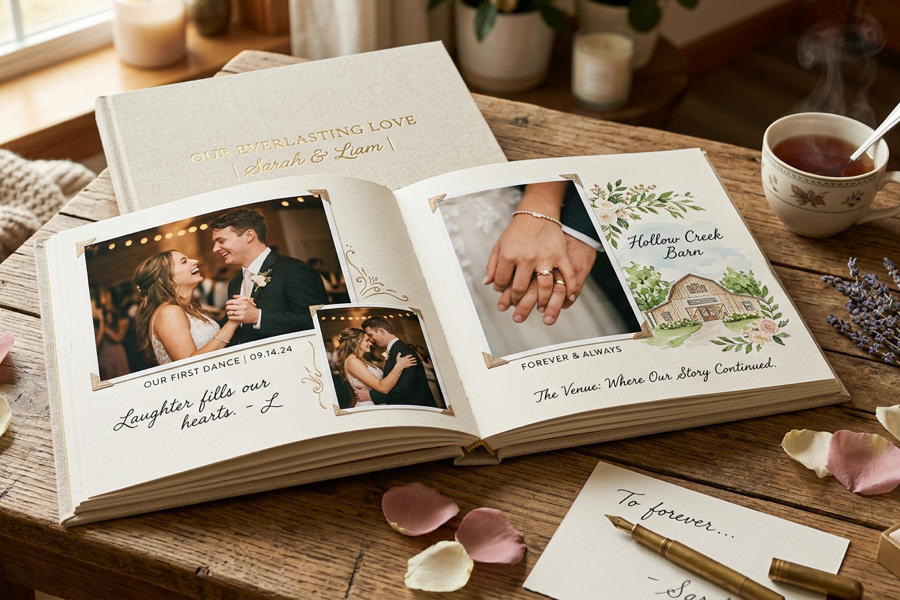
A professionally produced private memoir (especially with an edited audio highlights reel) is something else entirely. It’s a structured, narrative-rich volume that focuses on context and editorial craftsmanship. A photograph of your father crying during his toast is moving. That same photograph, paired with the exact text of his speech printed on the facing page, will be something your family returns to for generations.
Letting professionals take over the heavy lifting removes the organisational burden from the newlyweds. Working with private memoir specialists means that your wedding’s story receives the care it deserves.
FAQs about preserving wedding memories
What is the best way to preserve wedding memories?
Treat your wedding as a chapter in your family’s legacy. With intention, you can begin collecting stories before the wedding. For example, ask your dad to write down the thing he most wants you to know before he walks you down the aisle. Then, by the time the wedding day arrives, you’ll already have a wedding archive of stories in progress.
How do you record guest stories at a wedding?
The simplest approach is to assign a dedicated memory keeper, as described in detail above. They can either set up an audio/video station where guests can record themselves, or, if they’re gregarious enough, seek out folks for one-on-one conversations.
During wedding preparations and on the day itself, they’ll gather more living history in a short time than most families accumulate in a lifetime.
What are good questions to ask wedding guests?
For inspiration, here are some good questions to ask wedding guests:
- What would you tell your younger self about love, if you could?
- What is the funniest thing you have ever witnessed the bride or groom do?
- When did you first realise this relationship was different from the others?
- Describe the bride or groom in exactly three words and explain why you chose them.
- What family tradition do you most hope this couple carries forward in their marriage?
- What do you most want them to remember about today?
You don’t want to overburden guests with too many questions to answer, of course. Even if you choose just one to three prompts, you’ll still receive plenty of unique responses.
How do you turn wedding memories into a book?
There are, of course, photobook companies that make it fairly easy to create a wedding memory book yourself with pre-made templates. A family legacy, however, often requires greater attention to detail, which is something a professional memoir service can help with.
Not only can a memoir book service help narrow down the photographs and transcribe the speeches for you, but they can also organise all the disparate pieces thematically, creating a narrative arc for your wedding story.
They can take care of the tedious tasks, like editing and layout design since you’ve already done the heavy lifting of creating the archive of details to add.
Then, once the final book has been approved, it goes to an archival bookmaker who lends it the care and craftsmanship it deserves, including a sturdy, artisan binding that will last for generations.
How do weddings contribute to family history?
A wedding offers a rare historical snapshot of a family at a specific moment in time. The oral storytelling, advice-giving and family lore that circulate through those rooms define a family’s values for generations to come. It’s an event that also marks the continuation of your family’s unfolding story.
Written by Bailey, LifeBook Memoirs ghostwriter