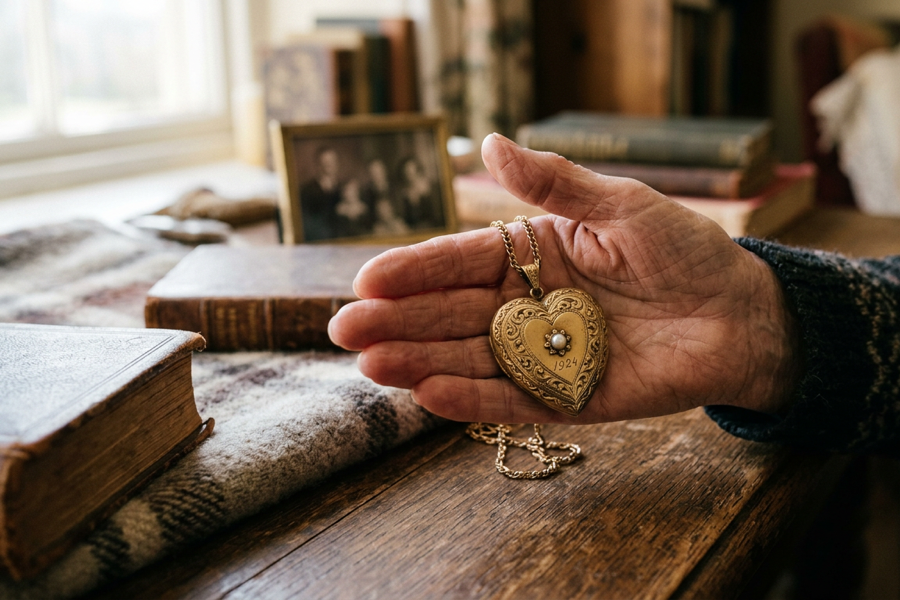
If you ask someone why they’ve kept their grandmother’s necklace, they probably won’t mention how much it’s worth. Instead, they’ll tell you a story: who wore it first, what it meant to different family members, or why it was never sold even when money was tight.
That’s the real meaning behind a family heirloom—the story that gets attached to it generation after generation.
Most people still think of heirlooms in terms of what they’re worth. It could be an antique sideboard worth a good price at auction or a piece of jewelry insured for its resale value. But ask the people who actually hold on to these objects, and money rarely comes up. A quick payday is fleeting. A story can last forever. What they’re holding onto is something else entirely, something no valuation could ever put a number on.
Personal power
Heirlooms can take many forms, but it’s the story behind each item that makes it so special.
A financially valuable item with little emotional value might be a nice thing to have, but it can also be a tempting target if you need some quick cash. Or maybe you inherited a piece of jewelry you’ll never wear or a piece of furniture that’s taking up too much space in your house.
When this happens, the personal link weakens until eventually you’d rather have the money than the object. Once that happens, the heirloom is lost forever to your family, along with any history behind it. This is why keeping these stories alive matters so much.
For an heirloom to keep its status, emotional investment must always outweigh all other considerations. That investment must look forward as well as back, so the heirloom can speak not only to the current generation, but to those still to come.
What happens when an heirloom’s story is lost
Every heirloom depends on someone remembering to pass its story on and pass it on correctly. If a detail gets left out or a name gets confused, the story can get muddled. And, eventually, the people who could once tell the whole story, with all of its unique detail, are no longer there to tell it.
At that point, what’s left is just an object. It might still be valuable. It might even be worth more than it ever was, since prices rise and fall over time. But that’s exactly the problem: a price tag is only ever a reflection of the moment you’re currently in—it has no memory of its own. The story, if it has survived, would have only grown richer with each generation that added their own chapter. Once that story is gone, there’s no getting it back.
The significance of the insignificant
We tend to think of jewelry or artwork when we picture an heirloom, but most are far humbler: a bobbin used by a woman working in a weaving mill, a decorative snuff box that was the constant companion of a Victorian ancestor, an identity tag that belonged to a Holocaust victim, a love letter from a soldier to his sweetheart back home.
These are unassuming items, but each one captures something of that person’s life and times. And each sends a message to their descendants about who they are, what they value, and the road they have traveled to reach this moment. No official record could tell you any of this. A census entry might give you a name, a date, or an address. It can’t tell you which desk drawer they spilled ink in, or why they kept that snuff box for years even though it wasn’t valuable. That kind of detail only survives in the object itself, and in the story someone chooses to tell about it.
How family heirlooms connect generations
Heirlooms preserve stories and identity, setting out a family’s place in history. A parent might give an object to their child, explaining why it matters to them and to the wider family. When that child eventually passes it on to their own children, the story is retold and, in this way, becomes attached to the object itself. This handover can continue through several generations, often long enough that the object outlives anyone who actually knew the person it first belonged to.
That’s part of what makes heirlooms so powerful: they can connect you to someone you never had the chance to meet. A great-great-grandmother’s wedding ring, a great-uncle’s pocket watch—these become a physical link to a person who exists for you only through what’s been passed down. In fact, the older an item becomes, the greater its significance as a link to the past, making it even more cherished. An heirloom can even inspire people to dig further into their family history, sparking conversations about what it means to belong to that family and deepening everyone’s sense of identity.
A sense of stability
In this fast-changing world, heirlooms are taking on greater significance, especially as interest in ancestry, culture, and heritage continues to grow. At the same time, our instant-gratification culture is making craftsmanship, quality, and longevity harder to find, as modern technology and materials render many traditional skills obsolete.
That’s precisely what sets an heirloom apart. It shows how things were once made to last and valued for it. It offers a sense of stability and continuity that’s often missing from the modern world. By its very nature, the heirloom is a survivor.
Creating togetherness through stories
By now, it’s clear that an heirloom is really just a vessel for something far greater than itself. But heirlooms don’t just carry old stories—they create new ones too.
There’s a particular feeling that comes with being given one. You’re not just receiving an object; you’re being trusted with a piece of who your family is. Even something small and ordinary can carry that weight and can bring back a person’s presence more vividly than any photograph, offering a kind of comfort that’s hard to put into words.
Heirlooms also have the power to create new family stories, whether through the conversations they spark or through their continued use, like wearing a piece of jewelry to a wedding, or cooking a family recipe that’s been handed down for generations. These moments often end up just as cherished as the object that inspired them. In this way, heirlooms aren’t fixed in time. They’re fluid, connecting the past with the present while carrying an anticipation of the future.
That’s where the strength of heirlooms lies: they draw people together and, in doing so, create a sense of belonging for everyone who treasures them.
The heirloom that keeps its story
Every family eventually faces the risk we’ve just described—a story fading, a detail forgotten, an object left behind with no one able to explain why it mattered. A LifeBook works differently.
Instead of leaving a story to be retold from memory, generation after generation, it captures that story once, in full, in your own words. An experienced interviewer draws out your memories in an unhurried conversation, and a professional ghostwriter shapes them into a book that still sounds unmistakably like you. You don’t have to sit down and write your whole life story from a blank page.
That includes the stories behind those precious objects you’ll one day pass down to your loved ones. A LifeBook lets you finally get down in words why these things matter to you, so the explanation doesn’t depend on being remembered correctly by whoever inherits them next.
And capturing your story with LifeBook Memoirs creates a new heirloom in the process. LifeBooks are bound by hand and printed on archival-grade paper that will last for hundreds of years. They’re built to be opened and reread for generations, not tucked away and forgotten. With a LifeBook, your life story sits alongside your family’s other heirlooms, but it does something no other object can: it carries its own context. No explanation needed—the explanation is woven through the pages.
Capturing the value you cannot measure
An heirloom is never really about the amount of money it’s worth. It’s about the hands the object has passed through, the stories surrounding it, and the people who chose to keep it in their lives. That’s the kind of value nobody can put a number on, and no amount of money can replace once it’s gone.
Every family has objects worth keeping, but few have the stories behind them written down. Whether you’re ready to tell your own story or want to give that gift to someone you love, that’s exactly what a LifeBook is for.

Written by Halima Crabtree, LifeBook Memoirs editor