When Yvette Conn first sat down to listen to someone else tell their life story, she had no idea how profoundly the experience would shape her own life.
Before co-founding LifeBook Memoirs with her husband, Roy Moëd, Yvette had spent years in the City of London, becoming one of a small number of female partners in a stockbroking firm at a time when few women held such positions.
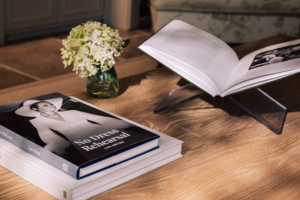
Clearly, the world of private memoirs was very different from the one in which she had thrived. Yet an early interview with a photographer who had commissioned his own memoir helped her see the power of a life story in a totally new way.
A life worth understanding
The photographer wanted to write his book so his family and friends would understand not only the broad outline of his career, but also the experiences, decisions and relationships that had shaped him. Over a series of meetings in his home, his memories began to organise themselves into a fuller picture of a life that would otherwise have remained largely unknown, even by those closest to him.
What stayed with Yvette was not just the content of the story, remarkable as it was, but the effect the recounting had on the man himself as he revisited his past with someone who was genuinely listening. He wasn’t just recalling his life – he was enjoying it.
That kind of attention is often quite rare. Most of us are only half-listened to in everyday life, whether at work or at home. However, a LifeBook interview gives someone permission to speak, pause and reflect in detail about memories that have not been discussed in years – not because they had been forgotten, but because nobody had shown the trouble or initiative to ask the right questions.
The finished book mattered to the photographer. But what mattered even more than that was being able to watch his children and grandchildren read it and discover things about him that they had never known: who he was, his values, his life choices, the people who influenced him, the trials and tribulations of his business life and the relationships that helped to define him.
The commission to interview the photographer was meant to be a one-off. Afterwards, Yvette returned to Roy with a list of ideas about how the memoir interview process could work even better. His response was simple: if she had so many good ideas, why not join the business? She went into the office the next day and never left.
At LifeBook Memoirs, we create private memoirs for individuals and families worldwide, capturing and preserving the stories that matter most to them. Through our custom OPUS division, we also produce legacy books for family businesses and tribute books built from loved ones’ memories.
A story worth preserving
Despite the range of people and families we work with, Yvette still sees the same hesitation at the start of the process, with many people believing that their lives are not interesting or worthy enough for a book. Yvette insists this is fundamentally wrong—anyone’s life story can fill a book.
Because what families risk losing is rarely just a set of dates or facts, but more often, the context of the author’s life: the private version of events that exists only in one person’s memory. People often assume they will have time to ask important questions later, or that those closest to them already know all that matters. However, that is rarely the case.
A carefully constructed memoir offers more than a record for future generations. It provides evidence that those who came before were more than names on a family tree; they were complex people with unique memories, challenges, ambitions, friendships and turning points.
Legacy is not measured only by achievement in a public field. Often, the most insightful stories are what someone carries with them. A quiet or private life can mean as much to loved ones as a life lived in the spotlight.
The photographer who first introduced Yvette to this work commissioned his book while he could still enjoy seeing his family read it. He did not wait until the end of his life to tell his story.
That, perhaps, is the real lesson. A life story is not simply something to leave behind, but a unique possession to share while there is still time for it to deepen relationships, prompt conversations and help families understand each other more fully.
Written by the LifeBook Memoirs editorial team