“After nourishment, shelter and companionship, stories are the things we need most in the world.”
~ Philip Pullman, British novelist and storyteller
There will be someone in your family whose life is worth recording. Perhaps they are in their seventies or eighties, still sharp as a tack and full of stories – stories about the work they’ve done, the places they’ve been, the people they’ve known and the many decades of change they’ve lived through. Perhaps you have always meant to sit down and ask them about it all, but you haven’t done so yet, and you’re not quite sure how to do it.
Or perhaps that person is you. You’ve reached a point where the life behind you feels worth setting down – not for the world, perhaps, but for the people who come after you and will one day want to know who you were.
A private memoir or autobiography is how that happens. Not necessarily published and not a self-produced scrapbook, but a professionally written, meticulously designed and permanently bound book, made in a small number of copies and given to the very people it was made for. Here, we explain how the process of creating one works.
What is a private memoir?
A private memoir – or private autobiography – is a professionally written life story created for family rather than for general publication. At LifeBook Memoirs, these books are produced in small, specified print runs and shared only with the people who matter most to the author – their family members, close friends and future generations who might never otherwise hear the story.
Memoir and autobiography are not the same thing, and the differences matter when choosing the right approach for a life story. What both have in common, in their private form, is this: they are not published. They will not appear on a retailer’s website, be submitted to a literary agent or be written with public readership in mind. That changes everything about what can be included. Without the constraints of commercial publishing – the need to interest strangers, to simplify, to perform – a private memoir or autobiography can be candid and personal in ways that public writing rarely manages.
In a private memoir or autobiography, the story isn’t for the world. It’s for family.
Who takes the first step?
Private memoirs are typically commissioned by one of three people: the author themselves, an adult child who wants to capture a parent’s life story or a family member gifting it to a loved one.
The project is sometimes personal – a decision made by the author to tell their story while they are able to tell it clearly. More often, it begins with someone else in the family recognising that a life is passing undocumented. Families frequently tell us that they came to LifeBook Memoirs after a health scare, a significant birthday or the death of another relative whose stories were never recorded. The motivation is rarely vanity. It is preservation: ensuring that a particular life, with all its detail and meaning, is not lost when the person at the centre of it is gone.
How does the LifeBook process begin?
At LifeBook Memoirs, the process of creating a private memoir or autobiography begins with an initial conversation, of which the purpose is to understand the shape of the life being considered.

In that first conversation, we discuss scope: Will this be a full life history or a narrative that focuses on one particular period? Who is the intended audience – immediate family, future descendants or a wider circle? What tone feels right – reflective, celebratory or honest? We also discuss practicalities: timeframes, the number and finish of copies needed, the incorporation of photo and audio material and how involved the author wants to be.
Many people arrive uncertain about whether their story is interesting enough to be worth recording. It always is.
From the first conversation onwards, each author is assigned a dedicated project manager – a single point of contact who coordinates every stage of the process, from scheduling interviews to liaising with the writing and production team, and who remains with the project from start to finish.
How are life stories captured?
At LifeBook Memoirs, we build private memoirs directly from recorded in-person, face-to-face interviews held with the author in their home or another place that feels comfortable. By design, we do not use written questionnaires, and this deliberate choice is central to the quality and character of what emerges.
Whereas questionnaires produce answers, conversations produce stories. When one of our skilled interviewers asks the right question at the right moment – the question that follows naturally from what has just been said – memory tends to open up in ways that a form cannot prompt. One recollection sparks another; a detail mentioned in passing turns out to be significant; a quick aside becomes an unexpected goldmine of recollection; a story the author had not thought about in decades surfaces because the conditions were right for it to do so.
Most LifeBook projects require between twelve and seventeen sessions with an interviewer, spread across several months. Many people are surprised by how much emerges naturally between these sessions: a story from one conversation will prompt a related memory overnight, and that memory opens up new territory in the next. Photographs, documents and even music brought to sessions can serve as prompts. A photograph that gathered dust in a drawer for thirty years, for instance, can unlock a story that explains an entire chapter of a family’s life.
How are spoken conversations turned into written narrative?
Once each new recording is complete, a professional ghostwriter reviews the transcripts, identifies the key threads and themes and shapes the material into a coherent, engaging narrative. This happens gradually, interview by interview, with each installment developing and expanding the narrative as more stories are told.
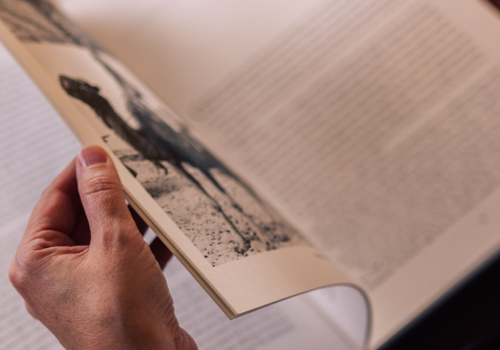
What we do not do is merely transcribe and collate interview conversations. Transcription and storytelling are not the same thing. A transcript is a record of speech, with all its natural repetitions, digressions, duplications and loose ends. A narrative has structure and refinement: it moves, breathes and sustains a reader’s attention. The ghostwriter’s task is to develop that structure while capturing the author’s character, tone and storytelling style without distorting what was said.
We do not go beyond what we are given in interviews – every claim, characterisation and detail in the finished narrative is grounded in what the author said, not in additional research or inference. Our decisions at this stage concern how to sequence events, handle recurring material and render the author’s voice in prose – choices shaped by conversations held before the interviews even began, in which we establish each author’s preferences for structure and tone.
The writing stage is where those choices play out in practice. Just as someone taciturn will speak in a measured, restrained way and read differently from someone more naturally expansive, so someone raised in rural Ceredigion or Kentucky will carry different cadences, idioms and instincts about language from someone whose English was shaped by the Caribbean or the Gorbals of Glasgow. Both can be represented authentically on the page by ghostwriters who are attentive to how the author uses language.
How does the author stay in control?
The author reviews and approves the manuscript at regular intervals throughout the interview process. On each occasion, before this happens, it is reviewed and developed by a professional editor independently of the ghostwriter who produced it.
This is not just a proofreading pass. Whereas ghostwriters work from the inside of a manuscript, editors read drafts as a reader – not as their maker – and bring a structural distance that a ghostwriter cannot. They identify where the narrative loses momentum, where sections are overdeveloped and where transitions are unclear or a chapter is out of sequence. They also ensure consistency throughout the manuscript.
The author then reviews and provides feedback to each review. Nothing proceeds from there or gets finalised without their consent. This is collaboration, not a formality. Corrections are made, gaps are filled and passages that don’t quite ring true are revised. Our editors are careful to listen to what sits uncomfortably for the author, whether matters of fact, tone or emphasis, and they work hard to respond empathetically.
What about photographs and personal material?
Treasured photographs and key documents can be included throughout the memoir, and most LifeBooks incorporate them.
With guidance, if requested, the author selects images and instructs us where to place them in order to complement the narrative – at relevant points of the book or grouped together. Each photograph and document is then captioned so that future readers understand who the people in the pictures are and what the occasion was or what relevance each document has to the author.
It’s not uncommon for older photographs to have faded or sustained damage, so our experts lovingly restore them to look their best in the finished book.
How is the physical book designed and produced?
LifeBooks are professionally designed and printed in small, specified runs – not printed on demand or produced to mass-market standards.
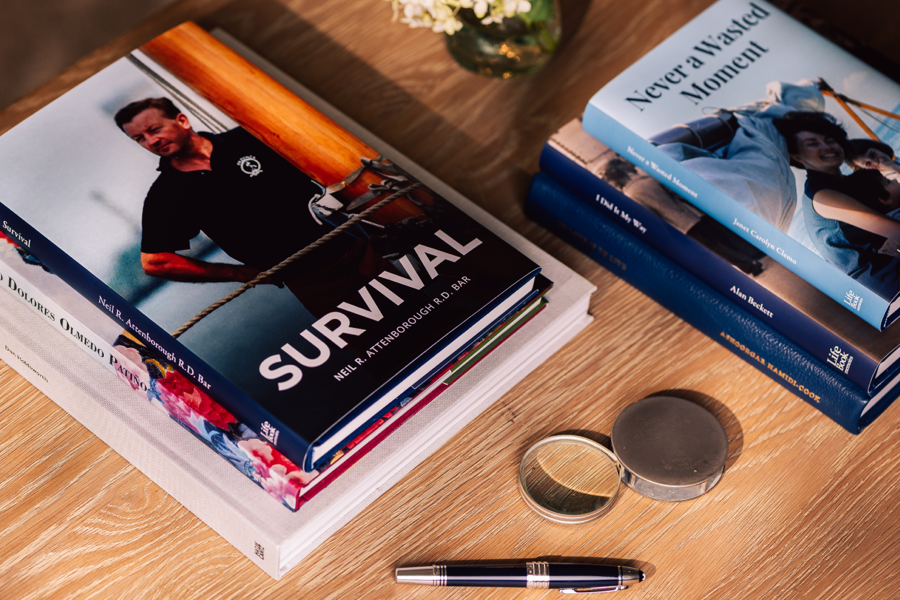
Manuscripts are typeset with careful attention given to readability: type size, line spacing, chapter openings and the use of white space are all considered. Covers are designed to reflect the author’s personality, and paper weight, binding and finishing materials are all selected with permanence and durability in mind, to secure the stories and memories in the book long into the future. Without fail, the result is an expertly bound volume built to be thumbed through and read for generations to come.
How does LifeBook Memoirs handle sensitive stories?
Privacy and discretion are paramount at LifeBook Memoirs. We handle all personal material with care. This is not a reassurance that we offer once and move on from – it is a principle that runs through every stage of the process.
We are often entrusted with stories of grief, estrangement, hardship, failure and regret that are among the most consequential moments of a life. Our writers and editors are experienced in handling difficult material with the weight that it deserves.
What goes into the memoir and what is left out is the author’s decision, not the ghostwriter’s or the editor’s. We do not judge which material should or shouldn’t be included – those decisions belong to the author alone. What the ghostwriter and editor do is take whatever the author has decided and handle it with the sensitivity it deserves: framing it clearly, positioning it thoughtfully and writing their story in a way that respects both the author and their readers.
Key points
If you are considering a private memoir for yourself or as a gift, here is the process in brief:
- Initial consultation. A first conversation to understand the life, agree the scope and confirm that a LifeBook is the right fit.
- Project team formation. A project manager – your point of contact for the duration of the project – is assigned, as are an interviewer, ghostwriter and editor.
- Recorded interviews. Guided conversations and photo-scanning sessions with an interviewer, spread across several months. Conversational, unhurried and prompted by photographs and documents.
- Drafting. A project team shapes the transcripts into a coherent narrative – ghostwritten and edited in the author’s voice.
- Collaborative review. The author reads and responds to successive drafts. Corrections and additions are made until the manuscript is approved.
- Design and production. The manuscript is typeset, illustrated with photographs and documents, proofread and reviewed by the author before being printed and bound by skilled craftsmen.
- Delivery. Finished copies are delivered.
The process typically takes between six and eight months, and the result is a permanent, private record of a life – kept within the family, made to last and handed down.
Written by Steve Edwards, LifeBook Memoirs editor