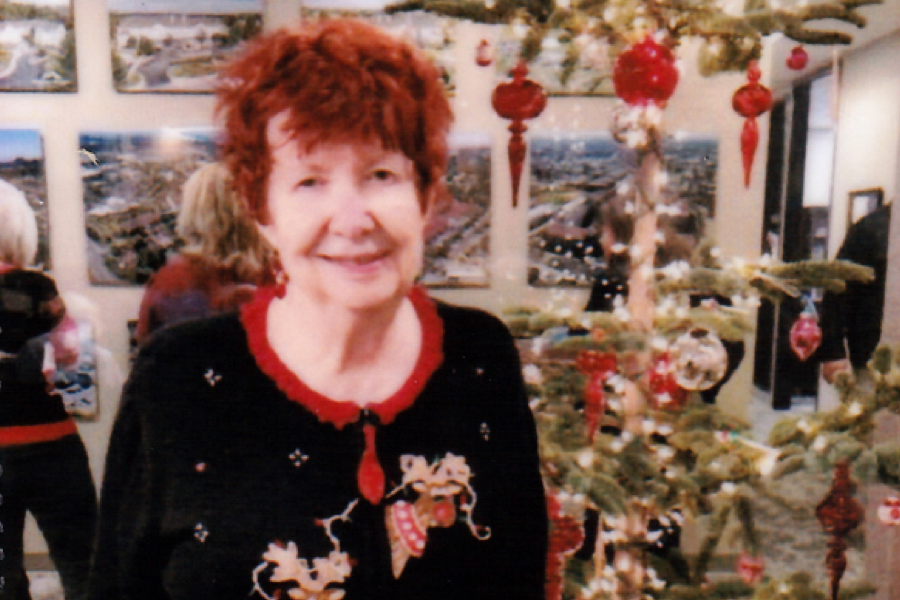
Over the decades, Carol Knox made a point of sending Christmas letters to family and friends. As she said, “These always covered the most important events of the year, at least one funny and true story, and the meaning or theme of the year”.
Having composed her story, she would determine a theme for each letter and come up with a name. The first letter, enclosed with her Christmas cards to around 100 people in 1994, detailed how she and her husband, Dean, had purchased a new home. At the time of purchase, it was only half completed, but Carol and Dean were able to personalise it in a way that would have proved more difficult with a fully established property. Subsequent letters covered subject matters such as her son, Sean, heading to South Korea to teach English and her daughter, Ranae, moving to Alaska to take a job as a physical therapist. Carol and Dean were able to enjoy trips of a lifetime to both places, which Carol describes with love, fascination and pride
There were many other overseas trips, including one to China in 2000, during which the sheer scale of the Great Wall, the Forbidden City, Tiananmen Square, the Empress Summer Palace, and the Terracotta Army left Carol in awe. There was plenty of content for the Christmas letter that year!
Often brutally honest and emotional, Carol’s letters reveal the fear that she felt after 9/11, the wonder of a twenty-three-day trip to Australia and New Zealand, the terrible ordeal of having her parents admitted to assisted care accommodation, her dismay at the election of Donald Trump as president in 2016, and, with the passing of time, the deaths of so many people dear to her heart, including her parents, her cousin John, and some close friends. Indeed, she branded her 2018 Christmas letter as ‘Age Old Struggle with Old Age’.
Carol’s 2020 letter is most poignant, describing the incredibly brave battle that Dean fought against aggressive cancer. Fourteen years previously, Sean had donated a kidney to his father after Dean had been diagnosed with an autoimmune disease that deeply impacted his kidneys. Tragically, Dean died in June 2020.
Such powerful and stirring letters make up only a section of Carol’s captivating story. She starts her book with her earliest memories of her upbringing in Montana and concludes with her golden years in senior living accommodation, inviting her readers into her world with an unwavering commitment to authenticity. She does not shy away from the hardships of loss, aging, illness and grief, but rather faces them with a refreshing and inspirational blend of humour and candour. In her prologue, Carol states that “everything can be seen as funny. It is the best survival mechanism of all, so I learned to laugh at myself.”
Her reflections on the challenges of being an only child, the joys and trials of marriage and motherhood, family, and the passage of time are particularly poignant. But whether her anecdotes are about high school embarrassments, adventures in New York City, or the realities of senior living, all are told with a self-deprecating wit that invites laughter and empathy in equal measure.
Carol’s motivation for turning to LifeBook Memoirs to help her tell her story was “the very sobering realisation that I may not live to be 100.” At age eighty-three, she decided that it was imperative to write her book “as soon as possible.”
In her Christmas letter of 2002, Carol wrote, “To all of our precious friends everywhere, with whom we’ve had so many good times and plan to ad infinitum, you’d better plan to live as long as we do, because we need you all in our lives, forever.”
Now firmly settled in her retirement home, Carol reflects on how, for the first time in her life, she is living in the moment, “feeling happy and joyful.” Each day is filled with laughter, love and peace as she helps those around her to laugh and feel loved.
In addition to a full and frank account of her life, Carol is keen to inspire others to live as happy a life as possible. She writes, “Gratitude makes you think about the good things in life and where they come from.
“If you can’t think of what your purpose is in life, make one up; it will keep you busy and away from the doldrums.
“People who keep it real don’t hide behind the persona to protect themselves from their fear of how they might be perceived. They acknowledge their wrinkles and laugh at their personal eccentricities without putting themselves down.”
What a wonderful approach to life! Thank you, Carol, for your inspiration, your humanity and your engrossing story of a life not only well lived, but beautifully lived.

Written by Stephen Pitts, LifeBook Memoirs editor